Sealed Disposable vs Replaceable Pod vs Refillable
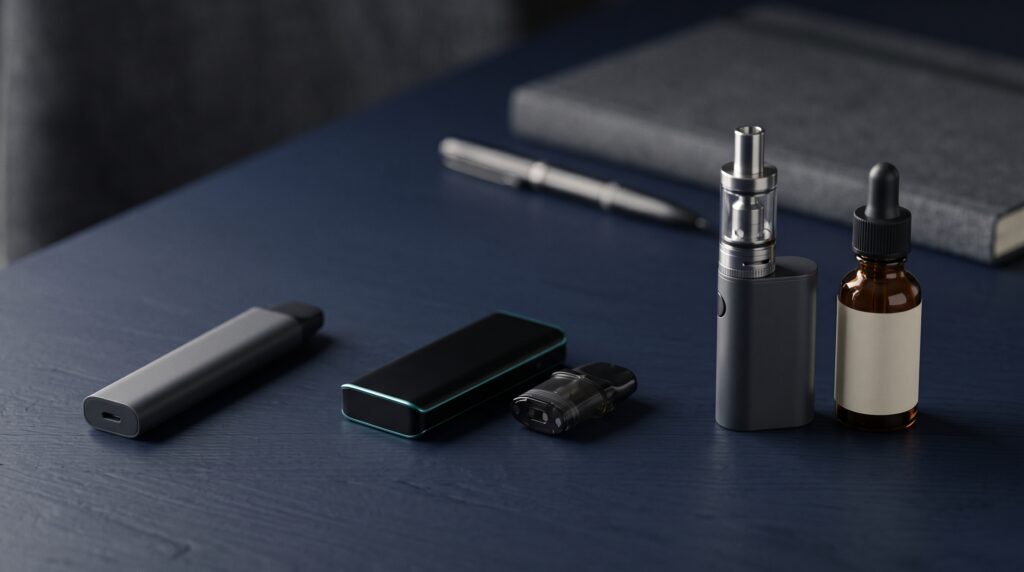
Sealed means the battery dies with the liquid. Modular keeps the battery. Refillable lets you choose liquid. Price per week usually follows that order.
Three hardware ideas are sharing the same shelf, often under the same “disposable” label. They are not the same purchase. The wrap can call all three a disposable. The hardware does not care what the wrap says.
This page is the split we use in reviews. Read it with how to read puff-count claims. The printed puff number will try to make a sealed bar and a modular kit look like the same class. Milliliters and whether you keep the battery are the better comparison.
Sealed disposable
Battery, coil, and liquid are one piece. When the liquid is gone, the whole unit is done. That is the oldest current form and still the most common photo on a shop page. High-capacity sealed bars now carry 12 mL, 18 mL, and more, plus screens and mode switches, but the structure has not changed. You buy a cell, you empty a tank, you throw both away.
Good for: simplest possible use, travel, trying a flavor without buying a bottle or joining a pod family.
Cost: you replace a battery every cycle. The first week can look cheap. The month usually does not.
Waste: highest of the three. Every finished tank is also a finished cell and a finished board.
A sealed bar can still earn a strong grade on this site. We do not punish the structure for existing. We punish it when the sealed design is a bad deal: harsh coil, dead flavor in the first third of the tank, or a battery that cannot keep up with the liquid it is welded to. Reviews such as the Geek Bar Burj 80K live in this class. Read the milliliters and the fade notes, not only the 80K line.
Replaceable-pod / modular kit
The battery stays with you. You swap a prefilled pod. Some systems sell spare batteries so one can charge while the other is in use. On this site, that is what “modular” means. It does not mean you can drop in any pod from any brand and expect it to fire.
Good for: high capacity without trashing a cell every time the liquid runs out.
Cost: better over a month if you stay in the same ecosystem and replacement pods are actually in stock at a sane price.
Catch: lock-in. The battery only earns its keep if you keep buying that brand’s pods. A five-pack bundle can make the math look excellent. A platform with scarce pods makes the reusable cell a paperweight.
American Standard, OXBAR-style platforms, DigiFlavor BRK-type splits, and similar kits reviewed here live in this class. The American Standard 50K is a clean example: 23 mL in the pod, 850 mAh in the unit you keep, Eco and Boost on the same coil. The structure is the point. The steampunk shell is not.
Modular does not repeal physics. A large tank on a modest cell still needs the cable. What changes is the annoyance. You charge a keeper. You do not buy a new board every time the mint runs out. That pairing is unpacked further in battery mAh vs e-liquid mL.
Open refillable
You buy liquid separately. You fill a pod or tank. You pick nicotine strength and flavor from a bottle. This is the older “vape kit” model. It has not disappeared. It just stopped being the default photo on a product page that wants to look like a disposable aisle.
Good for: control and long-term cost. Milliliters from a bottle are almost always cheaper than milliliters sealed inside a throwaway bar.
Catch: more steps. Filling, coil or pod changes, and leaks if you rush. People who wanted zero maintenance did not fail at vaping. They picked a different structure.
Some current kits sit on the line. A device can be refillable and still look like a high-capacity disposable. The iJoy XP100K is in that conversation: extreme claimed capacity, modular hardware, and a refill path rather than a sealed one-and-done bar. When a review on this site calls a kit refillable, believe the fill port, not the puff number printed beside it.
How we treat them in grades
The letter is about daily use, not about which church the hardware belongs to. That rule is in how Vape Verdict grades work.
We do not give a modular kit a free A for being modular. The pod still has to taste right, and the battery still has to last a day. We do not give a refillable kit a free A for being cheaper per milliliter. If it leaks on a Tuesday, that is in the cons.
Structure belongs in “who it’s for.” The letter belongs to the week you actually spent with the device, which is the method in how we test a device.
A simple way to choose
- Want zero maintenance for a weekend: sealed.
- Want high capacity without buying a new battery every cycle: modular.
- Want to pick your own liquid and spend less per month: refillable.
If a product page calls a modular kit a disposable, believe the hardware, not the headline. If two devices claim the same puff count and only one lets you keep the cell, they are not the same class. That is the whole page.
These are adult nicotine products. In the United States they fall under FDA tobacco-product rules for electronic nicotine delivery systems. That fact does not tell you which structure to buy. It does tell you the audience is adults, not a toy aisle.
Related
What “modular” and “USA-made” change in real use (next in this set; URL will match the slug)